
LESSON 08 / AERODYNAMICS
The four left-turning tendencies
Torque reaction, P-factor, spiraling slipstream, and gyroscopic precession are the four propeller effects commonly called left-turning tendencies. Their direction and whether they cause roll, yaw, or pitch depend on propeller rotation and flight conditions.
Your learning goals
- Match each tendency to its primary motion and axis.
- Distinguish engine reaction, asymmetric thrust, and a force on the tail.
- Explain why gyroscopic precession does not always cause left yaw.
- Relate the effects to the aircraft’s motion and operating conditions.
“Turning” can mean different motions.
Our reference airplane: a conventional single-engine tractor airplane, with a front-mounted propeller turning clockwise as viewed from the pilot’s seat looking forward. Left and right always mean the airplane’s left and right. Viewed from in front, the same propeller appears to turn counterclockwise.
The familiar name is “four left-turning tendencies,” but these effects do not all act about the same axis—and they do not all act left in every condition.
| Tendency | Motion | Axis |
|---|---|---|
| Torque reaction | Left roll in flight | Longitudinal |
| P-factor | Left yaw with positive inflow angle | Vertical |
| Spiraling slipstream | Usually left yaw at the tail | Primarily vertical |
| Gyroscopic precession | Pitch change → yaw; yaw change → pitch | Vertical or lateral, depending on the input |
Review the three axes if the names feel backward. “Longitudinal” means the long, nose-to-tail direction.
01 / AN OPPOSITE TWIST
Torque reaction
Primary effect: left roll · longitudinal axis
The engine applies torque to turn the propeller clockwise. The engine–airframe combination experiences an opposing reaction, tending to rotate the airplane counterclockwise from the pilot’s viewpoint. In flight, that means the left wing tends to drop.
Think of the twist you feel in your hand when a drill drives a screw: the tool reacts opposite to the turning action. In the airplane, the reaction is a rolling moment, not a direct sideways pull on the nose.
The rolling moment follows engine torque. High-power, low-airspeed conditions commonly make the tendency more noticeable, but its size and the correction needed depend on the airplane.
Why can torque also make the airplane yaw on the runway?
On the ground, the rolling tendency can increase the load on the left main wheel. Increased rolling resistance on that side can then produce left yaw about the vertical axis. This is a ground-mediated consequence of torque, distinct from its primary rolling effect in flight.
02 / UNEVEN THRUST
P-factor
Primary effect: left yaw · vertical axis
When the propeller shaft points upward relative to the flight path through the air, the airflow meets the propeller obliquely. For our clockwise-turning propeller, the descending blade on the right produces more thrust than the ascending blade on the left.
The combined thrust acts to the right of the centerline. Pulling forward harder on the right side swings the nose left—much like pulling one side of a shopping cart ahead of the other.
P-factor is especially relevant at high power and a large positive inflow angle, such as in slow flight. It depends on the propeller’s relationship to the airflow, not simply on the nose’s relationship to the horizon. A climb is not required, and a nose-high attitude alone does not determine it.
Are the two blades turning at different RPM?
No. They rotate together. Their motion combines differently with the oblique incoming airflow, producing different resultant velocities and blade loading on the two sides of the disk. In ideal symmetric inflow along the shaft, this P-factor asymmetry disappears. A reversed inflow angle can reverse the yaw tendency.
FAA PHAK, pp. 5-32–5-33: Asymmetric Loading · FAA glossary: P-factor
03 / A PUSH ON THE TAIL
Spiraling slipstream
Primary effect: left yaw · vertical axis
The propeller accelerates air backward and gives it a swirling motion. This slipstream wraps around the fuselage. In the conventional arrangement shown, it reaches the left side of the vertical tail and pushes the tail right. With the tail pushed right, the nose yaws left.
Unlike P-factor, this explanation puts the sideways force at the tail, rather than shifting the propeller’s thrust to one side. High propeller speed and low forward airspeed tend to make the spiral more compact and its tail effect more prominent.
Does slipstream only cause yaw?
No. Swirling flow can also create a rolling moment about the longitudinal axis. The FAA describes a right-rolling contribution in its conventional example. The left-yaw effect at the vertical tail is the primary tendency being taught here; actual rolling and yawing effects depend on the airframe and flight condition.
04 / CHANGE THE SPINNING AXIS
Raising the tail produces left gyroscopic yaw.
Pitch input → yaw about the vertical axis
A spinning propeller has angular momentum. Changing the direction of its spin axis requires a torque, with a gyroscopic reaction on the airplane. A pitching motion about the lateral axis produces a yawing moment about the vertical axis. A yawing motion can likewise produce a pitching moment about the lateral axis.
During a tailwheel takeoff roll, forward elevator pressure raises the tail as the airplane accelerates. Tail up means nose pitching down. For our propeller turning clockwise from the pilot’s seat, that pitching motion produces a left-yaw gyroscopic contribution. This is the example commonly taught with the left-turning tendencies.
The opposite pitch change reverses the effect: nose up → right gyroscopic yaw, as during nose-up rotation or a flare. A steady nose-high attitude does not keep producing this pitch-induced contribution.
| Pitching motion | Gyroscopic yaw | Response axis |
|---|---|---|
| Nose pitching up / tail lowering | Right | Vertical |
| Nose pitching down / tail rising | Left | Vertical |
The direction follows the pitch change, not the landing-gear type. Calling it “usually right” or “always left” hides that relationship. The pitch-induced contribution depends on pitch rate and the propeller’s angular momentum. Holding a constant pitch attitude does not, by itself, produce that contribution. This effect can occur in nosewheel airplanes too; it is especially associated with the tail-raising motion of tailwheel airplanes.
What does “90° ahead in the direction of rotation” mean?
The FAA’s rim-force picture locates the response 90° around the spinning disk in the direction of rotation. It is a spatial relationship used to understand the gyroscopic response—not a 90° heading change or an instruction to wait a quarter-turn. The practical question is: which way is the propeller’s axis being tilted?
Different causes can act together.
Torque: opposite twist.
P-factor: uneven propeller thrust.
Slipstream: a sideways push on the tail.
Gyroscopic: a reaction to changing the spinning axis.
During a high-power, low-speed takeoff, several effects can overlap. A nose-up pitch change may create a right-yaw gyroscopic contribution while P-factor and slipstream still contribute left yaw. The net response is what matters.
Ailerons primarily control roll, rudder controls yaw, and elevator controls pitch. Right rudder may counter a net left-yaw tendency; it does not directly cancel the engine’s rolling torque. Use the controls needed for alignment, attitude, and coordination, following the aircraft’s AFM/POH and flight instruction—not a fixed control input for a memorized label.
Reversing propeller rotation reverses the directional examples for otherwise equivalent conditions. These diagrams describe tendencies, not guaranteed motion in a trimmed or actively controlled airplane.
EXPLORE / FOUR STATIC DEPICTIONS
Find the force. Name the axis.
Each sketch isolates one effect. Arrows show direction, not measured force or motion. The propeller convention is clockwise from the pilot’s seat.
1. Torque: the wing drops
Roll · longitudinal axis
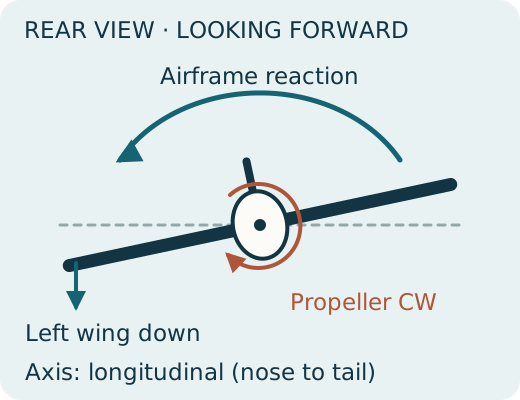
View: from behind the airplane, looking forward. The orange arrow shows propeller rotation; the teal arrow shows the opposite rolling reaction. The dashed line is the original wings-level reference.
Return to the explanation →2. P-factor: thrust is off-center
Yaw · vertical axis
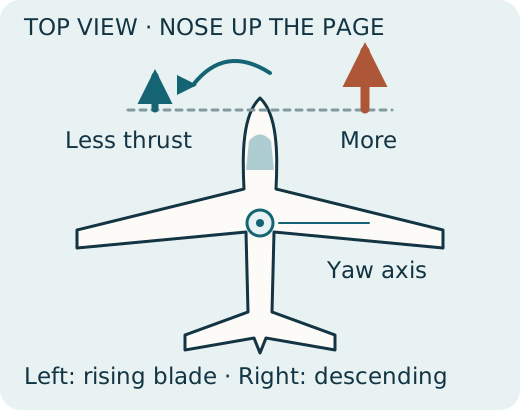
View: from above, with the nose toward the top of the page. The arrows represent thrust from the two sides of the propeller disk, seen edge-on as a dashed line. A positive inflow angle is assumed; it is not visible in this top view. The circled dot marks the vertical axis through the airplane.
Return to the explanation →3. Slipstream: the tail is pushed
Yaw · vertical axis
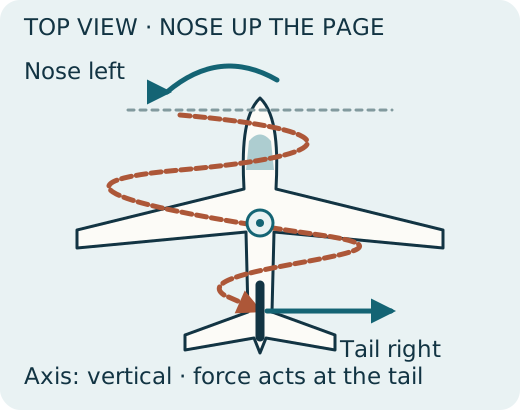
View: from above. The orange trace is a simplified projection of a three-dimensional spiral, not a calculated streamline. Its force on the left side of the vertical tail moves the tail right; the nose swings left.
Return to the explanation →4. Gyroscopic: tail rises → nose yaws left
Lateral-axis input · vertical-axis response
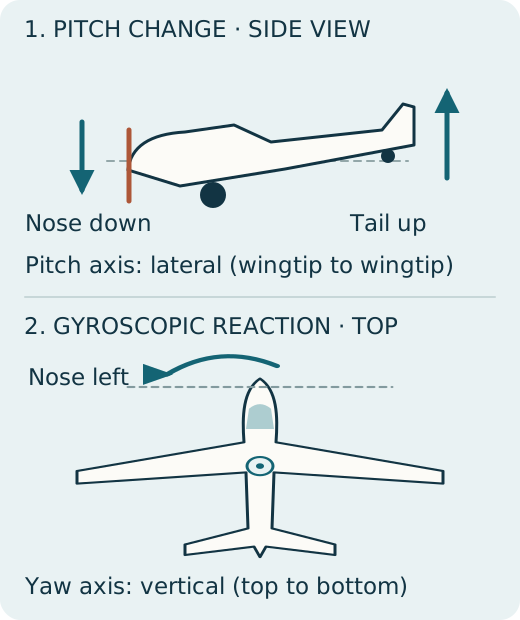
Tailwheel takeoff roll: as the airplane accelerates, the pilot applies forward elevator pressure to raise the tail. The tailwheel lifts off the ground as the nose pitches down about the lateral axis.
Bottom panel: that nose-down pitching produces a left-yaw gyroscopic contribution, for a propeller turning clockwise from the pilot’s seat. The pitch-induced contribution stops when the pitching motion stops.
Opposite motion: pitching the nose up produces right gyroscopic yaw. That is a different case from raising the tail during the takeoff roll. Follow the aircraft’s procedures for takeoff technique.
Return to the explanation →SUMMARY
Diagnose the motion before the label.
The left wing drops in flight after a power increase. Which primary effect fits?
Torque reaction: left roll about the longitudinal axis. A wing dropping is roll, not yaw.
The propeller’s right side produces more forward thrust. Where does the nose go?
Left, about the vertical axis. This is P-factor under the positive-inflow, clockwise-propeller conditions described.
A tailwheel airplane’s tail is rising. Which axes are involved in the gyroscopic effect?
The pitch change is about the lateral axis. The gyroscopic left-yaw tendency is about the vertical axis, for the stated propeller rotation.
Common Student Pilot Questions
Is P-factor the same as torque?
No. In flight, torque reaction primarily creates a rolling moment. P-factor is asymmetric propeller thrust that primarily creates a yawing moment. Both effects can occur together.
What does clockwise propeller rotation mean in this lesson?
It means clockwise as viewed from the pilot’s seat looking forward. Viewed from in front of the airplane, that same propeller appears to turn counterclockwise. The rotation convention matters when predicting the direction of an effect.
Does gyroscopic precession always yaw the airplane left?
No. For this clockwise propeller, pitching the nose down produces a left-yaw tendency; pitching it up produces a right-yaw tendency. The response depends on how the propeller’s axis is being tilted.
PRACTICE
Flashcards and knowledge check
Six flashcards, then five questions on causes, axes, and direction.
Enable JavaScript for flashcards and the knowledge check. The lesson and scenario remain available without it.
Sources & lesson notes
Lesson sources
- FAA — Pilot’s Handbook of Aeronautical Knowledge, Chapter 5, pp. 5-30–5-33Torque Reaction, Corkscrew Effect, Gyroscopic Action, and Asymmetric Loading; Figures 5-47 through 5-51. These sections supply the rotation convention, axes, and conditional effects used here.
- FAA — PHAK Glossary, P-factor and Asymmetric ThrustDescending/ascending blade loading and the propeller-axis relationship to the relative wind.
The static illustrations are original teaching diagrams, not aircraft-specific performance or control-input charts.